As published by Popular Archaeology September, 2013
Buried for more than 4,500 years, a well-preserved ancient Egyptian funerary bark sees the light of day, aided by archaeologists and Japanese technology.
Cairo, Egypt -- Made from Lebanese cedar, the planks of the ships were masterfully pieced together. Strong and buoyant, these vessels were designed to move gracefully across a cosmic sea to transport a king across the heavens after death. They were Pharaoh Khufu's “solar” boats, and sailing by his side would be the god Re, the Egyptian sun god, embodying a testament to his piousness as a ruler and the blessings of the gods in his journey through the afterlife. Because the boats’ most important journey was intended to be a cosmic one, they may have seen little or no use in water like other ships. These boats were buried beside his pyramid tomb and hidden for thousands of years.
The king, his body silent in death, kept the secrets of the boats with the desert.
But those who unearth the past take joy knowing that no secret can remain forever. In 1954, while famed Egyptologist Kamal el Mallakh was conducting a routine cleaning at a dig site, he discovered two large wooden funerary boats buried beneath the Great Pyramid on the Giza Plateau. Only one was removed and reassembled (pictured left, and below). It now resides in the Giza Solar Boat Museum, a futuristic looking structure at the base of the Great Pyramid.
The other remained hidden and untouched for over 30 years.
Then, in September of 1987, Japanese researchers reconfirmed the presence of the second boat, resting below large limestone slabs. One month later, a group of archaeologists sponsored by the National Geographic Society drilled a hole in the limestone slabs around the boat to insert a small camera, revealing the wooden planks. They also took air samples and resealed the pit. However, the seal of the entombed boat had been breached and water from the museum as well as insects and fungi began to degrade the ancient, vulnerable wood. Extensive analyses were conducted of the wood in 1992 and 1993 by Japan's Waseda University. A technique known as X-ray diffraction analysis allowed the researchers to conclude that there was severe damage to some parts of the wood, and the preservation and eventual removal of the boat became a priority.
In June, 2011, the Waseda team began removing the 41 large stone slabs that had covered the boat. It was a monumental task. Measuring 4 meters long and weighing roughly 14 tons each, the ancients clearly intended them to be worthy gatekeepers, shielding the boat for millennia. The excavators then covered the area with chemically treated wood in order to maintain a uniform temperature and humidity within the pit.
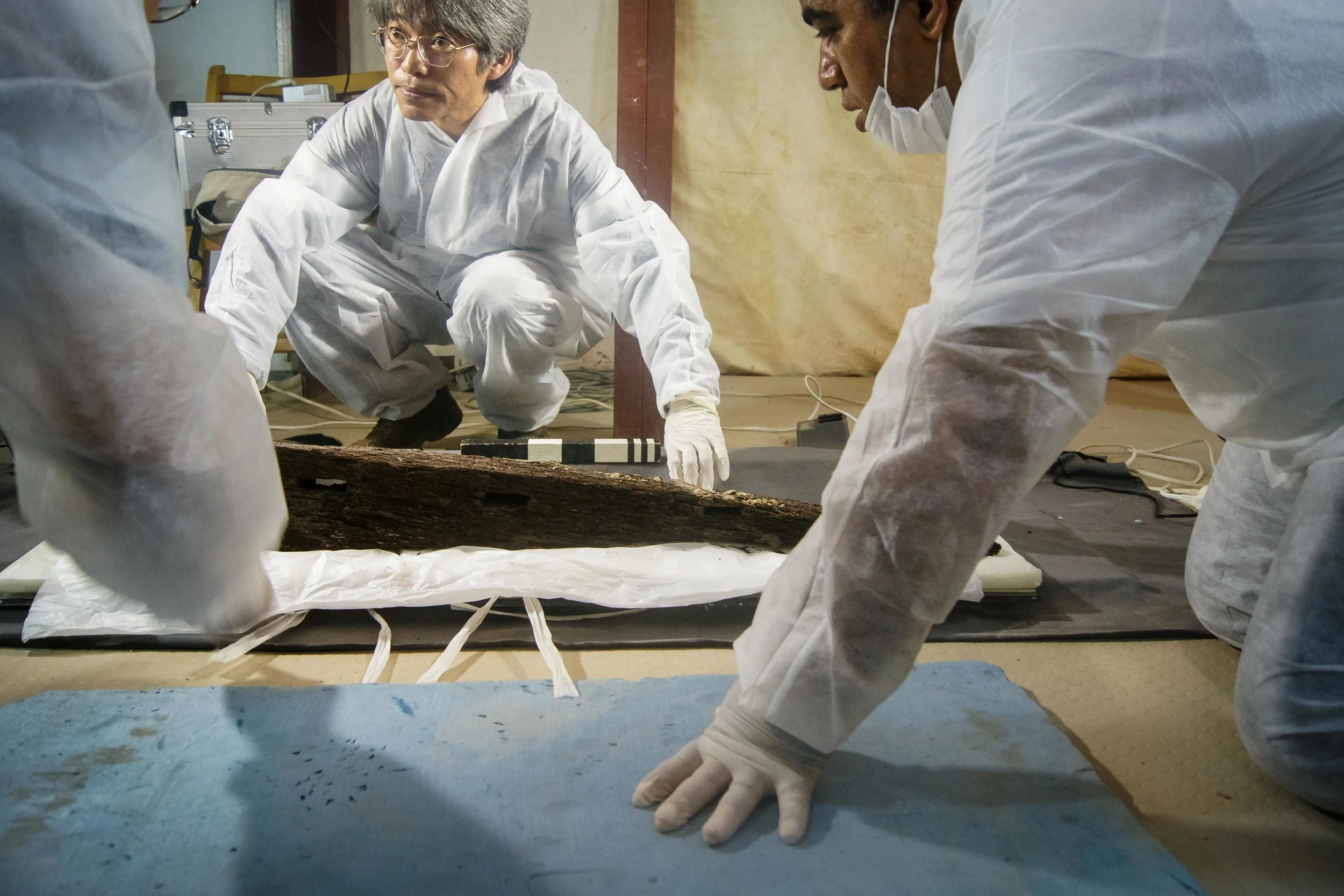
But it wasn't until June of 2013 when they actually began removing the boat from its in situcontext, piece by piece. Project workers built an excavation hangar to protect the site, equipment, and workers from the elements. A generator powered lights and imaging devices within. It was a hot, cloudless day when (now former) Minister of State for Antiquities Ahmed Eissa arrived at the dig site, flanked by rows of bodyguards. This was to be the first day when, after thousands of years, pieces of the boat would be removed. To mark the importance of this crucial stage in the excavation process, Toshiro Suzuki, the Japanese Ambassador in Cairo and Dr. Sakuji Yoshimura, Egyptology Director for Japan’s Waseda University, joined him.
The goal of the day was for the Minister, along with Dr. Yoshimura, to publicly remove the first few planks of the ship. With mild fanfare, they donned pristine white, hooded suits and masks. Given the frailty of the barge, only a small group was allowed to safely enter. An impromptu tent was set up outside the site, with video monitors to stream the initial extraction of the cedar planks. It provided the only shade as far as the eye could see. A crush of journalists huddled their way from the blazing sun into the tent, eyes trained on the screens as the removal of the cedar strips began.

Since that opening day, the team, wearing white, protective suits, has been racing against a series of environmental adversaries. They are not just tackling the time-induced decay of the organic material, but also the deterioration aided by insects and water damage. Thus, every few seconds there is a staccato exclamation in Japanese or Arabic, and though the shouts of caution are strong, hands and movements are quick, careful and gentle. Like bees in a hive, the workers huddle around each extracted piece. Their hands are methodical; they swaddle the wood in composites of cloth. Soon, other workers will create three-dimensional renderings of each piece, allowing them to painstakingly document, study and account for each part of the boat.
According to University of Berkeley’s archaeologist and Egyptology expert Carol Redmount, solar boats were primarily a practice of the Old Kingdom pharaohs (2686 BCE- 2181 BCE). It was in the 3rd Dynasty, actually before Khufu, that these boats typically became associated with kings. While some royals were buried without any boats, experts believe Khufu was buried with at least 5 different ships. Some of his boat pits were found empty, but these two full-sized ships beside his Great Pyramid truly captured the attention of archaeologists and historians.
And nothing captured their attention more than when the researchers discovered a cartouche bearing the name of Khufu within the context of the second boat. This exciting find led them not only to confirm the ownership of the boat, but also suggested that this boat may even predate the first, fully reassembled boat. If validated, the second boat could rightfully boast the claim as one of the most important archaeological finds of ancient Egypt. Using Carbon 14 dating, along with the evidence of the vessel's ownership and historical records, the team has placed the age of the ship at more than 4,500 years.
Although Egyptologists are certain the boat now being removed belonged to the late 4th Dynasty ruler Khufu, they are less certain about the function of the boat. Unlike other ancient funerary boats, such as those uncovered in Europe, no bodies were placed within it. This suggests it had a more spiritual and religious function.
"They are usually called 'solar boats' because of the belief of many scholars that the boats were for the symbolic use of the king in the afterlife to sail the cosmic waters with the sun god,” says Redmount. “The solar boat interpretation thus suggests that the boats were used to transport the king to the Sun god Re, as well as accompany Re in his voyage across the sky."
But why did Khufu need five entombed boats? One interpretation of Khufu’s assemblage of buried boats is that four of them were meant to ferry the king to the four cardinal points of the universe, and that the fifth boat would have actually transported the king's body to the pyramid. And while some boats do in fact show slight usage, it remains the general consensus that the boats had a more spiritual, rather than literal, meaning.
The excavation and restoration project is a partnership between the Egyptian Ministry of State for Antiquities, the Japanese Institute for Restoration Research, and, as already mentioned, Tokyo's famed Waseda University. At first glance, Japan and Egypt seem to be odd companions. However, for those at Waseda, the union, as well as Japan's commitment to Egyptology, is well in line with the Japanese approach to archaeology.
Waseda first sent an exploratory mission to Egypt in 1966, and later received approval (the first for an Asian state) to begin excavations in 1971. Among those early trailblazers was a young Sakuji Yoshimura, who would later become the Director of Egyptology at Waseda. While Yoshimura and his colleagues were giddy at the prospects of unearthing untold treasures, they knew that the road would not be easy. Western archaeologists had a 200-year head start over Waseda, and any hope of innovating with Western archaeological techniques was bound to set the team back even further. So they decided to take a uniquely Japanese approach to Egyptology. And because Japan's ancient religions were polytheistic, unlike the Western tradition of monotheism, the Japanese archaeologists believed they could better understand the motivations of the equally polytheistic ancient Egyptians.

"Japanese culture, history and values must be useful in some way for understanding and reconstructing the ancient Egypt," Professor Jiro Kondo of Waseda has told the public.
Technological advances have also played a key role in asserting Japan's place in the field of Egyptology and archaeology. The existence of Khufu's second boat, confirmed by the Japanese team in 1987, is credited to the team’s use of Ground-Penetrating Radar (GPR) technology, a pioneering application for archaeology at that time. With GPR, radar pulses are emitted into the ground to create an image of the subsurface. Fortunately for the Japanese team, this method worked particularly well in sandy areas, given the uniform makeup of the ground. Their early use of these non-destructive methods has been invaluable in areas where preservation is key, including the use of CT scans and 3D imaging for reconstruction of the remains of temples and the faces of deceased rulers.
"Japan is not aiming to conduct research in imitation of Western academic systems. But Japan's advantages lie, I hope, in disadvantages or a void in the Western academic tradition," says Dr. Kondo.
The sister of this solar boat, now housed in the adjoining room and open to eager tourists, underwent more than 20 years of restoration and reassembly. Those intimately involved in this new project hope the advent of applied technology will dramatically drop the time needed to piece together this one. They are cautiously optimistic that the boat will be reassembled within 5 years, even though they have 13 different layers of wood to remove, study, and preserve. The end result will be a fully assembled boat on display at the entrance of the Giza Plateau, while the first solar boat will be moved to the new Egyptian Museum.
Along with other iconic treasures found in Egypt over the past few centuries, this one will likely add more to the world’s knowledge about the life-ways of pharaohs and the ancient Egyptian people. Like the others, it will also fire the popular imagination.
“The boat is a spectacular piece of engineering and building, and also provides insight into technology, trade, and aesthetics” effuses Salima Ikram, head of the Egyptology Unit at the famed American University in Cairo. “It is truly amazing to think that King Khufu actually might have travelled on this boat, after having ordered it to be made from cedar logs brought all the way from what is modern day Lebanon.”
One wonders what Pharaoh Khufu would say if he could be here to see this. Would he want it reburied, or would he regard its public display as an extension of his own eternity, part of his journey through the afterlife that his boat now, in a very real sense, is making possible?


